
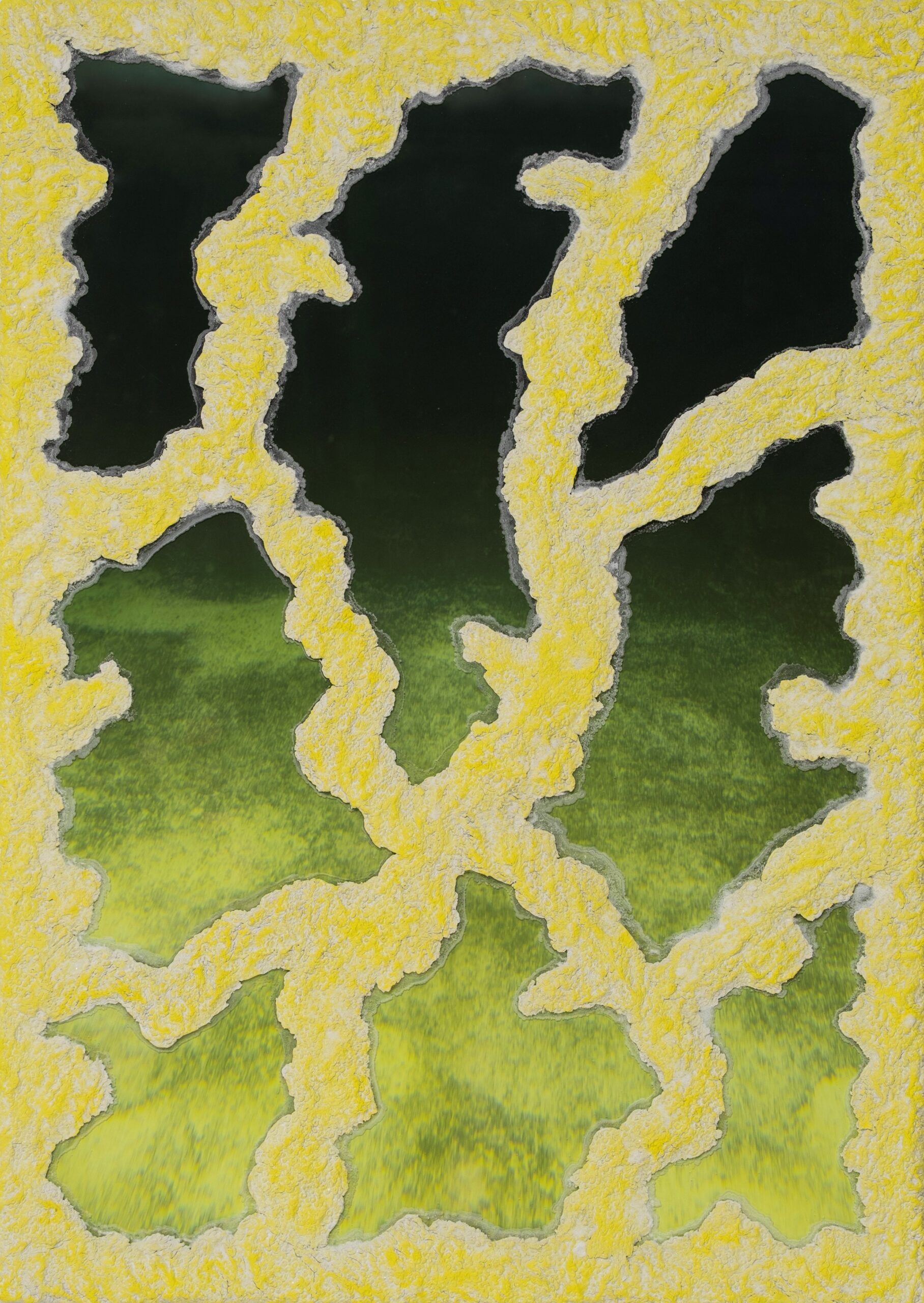
Drifting Through Waters | November 14 – December 6, 2026 | Paris
Artists: Kristina Õllek, Anne-Laure Wuillai
Curators: Merilin Talumaa, Kati Kull
Organisers: Roots to Routes in collaboration with nomaadgalerie
Researchers: Dr Andrea M. Doglioli, Dr Johannes Karstensen
Address: 47 rue Chapon, 75003 Paris
Opening reception: 13 November, 18:00–21:00
Sunday brunch & exhibition tour with the artists: 15 November, 12:00–15:00
Exhibition dates: 14 November – 6 December 2026
Opening hours: Tuesday–Saturday, 11:00–18:30
To drift is to surrender to a movement whose direction cannot always be known. It suggests a state of suspension, of being carried by currents that may lead somewhere unexpected, or nowhere at all. Beneath the seemingly endless surface of the sea, invisible processes unfold: organisms flourish and disappear, sediments accumulate, and traces of human activity travel through water, often far beyond their point of origin. There is both beauty and unease in this constant movement, a sense of life unfolding alongside the possibility of its disappearance. Bringing together Estonian artist Kristina Õllek and French artist Anne-Laure Wuillai, Drifting Through Waters explores this fragile and shifting territory between what we can observe and what remains hidden, between the sea as a source of life and as a witness to profound environmental change.
The exhibition unfolds between two bodies of water, the Baltic Sea and the Mediterranean, and two ways of approaching their changing realities. At its heart is a meeting between artistic imagination and scientific research, initiated through new collaborations established in 2026. Kristina Õllek entered into dialogue with Dr Johannes Karstensen at GEOMAR Helmholtz Centre for Ocean Research Kiel, while Anne-Laure Wuillai began working with Dr Andrea M. Doglioli at the Mediterranean Institute of Oceanography, Aix-Marseille University. Through these exchanges, observations gathered in the field, scientific knowledge, and artistic experimentation begin to flow into one another. The resulting works bring fragments of these conversations into the exhibition space, opening other ways of sensing and understanding marine environments. These encounters are not intended to end with the exhibition but to continue as long-term relationships between the artists and researchers.
For Kristina Õllek, the sea is a living environment in which geological histories, microscopic organisms, and human interventions are inseparably intertwined. Her long-term engagement with the Baltic Sea has led her to investigate oxygen-depleted waters, cyanobacterial blooms, and the fragile conditions of marine life. Moving between photography, installation, and microbial and chemical processes, Õllek allows the materials themselves to participate in the making of an image. In works such as Aerial view. Sedimenting Sediments (2024) and Cyanobacterial Bloom Index (2024), photographic surfaces are transformed through the growth of sea salt crystals, combined with cyanobacteria and fluorescent pigments. These materials evoke the processes of accumulation and transformation taking place within the Baltic Sea, where nutrient pollution and rising temperatures contribute to the proliferation of cyanobacteria and the formation of oxygen-depleted zones. While Õllek allows marine materials to transform the image itself, the resulting works become more than representations of the underwater world: they carry within them traces of the very processes they seek to reveal. These investigations continue through three new works shaped by dialogues with researchers at GEOMAR in Kiel, extending Õllek’s exploration of the changing conditions of aquatic ecosystems. Comprising Drifting Through Benthic (2026), Drifting Through Samples of Waters (2026), and Breathing Sulfur (2026), the pieces fuse photography, clay and encrustations of sea salt. They possess a strange, otherworldly beauty, evoking landscapes that seem to belong simultaneously to a distant past and an uncertain future. They are bound together by a distinct yellow that carries a dual resonance: the shifting presence of sulfur-breathing Beggiatoa bacteria weaving across hypoxic sea floors, and the bright, industrial hue of underwater research equipment seeking answers in the dark. Through this tactile interplay of materials, the shifts within these works emerge as something deeply unsettling, yet unexpectedly alluring.
In the work of Anne-Laure Wuillai, the sea becomes something to collect, contain, preserve, and perhaps ultimately lose. Through sculptures, installations, and drawings, she explores the human desire to bring the vastness of water within reach, to transform it into an object of knowledge, memory, or possession. In Bibliothèque d’eau de mer (2021), seawater enters the ordered world of a library, suggesting an archive of something that is, by its very nature, impossible to fully preserve. Her Cartes postales (2025), Encriers (2026), and Porte-conteneurs drawings (2025) further evoke the ways in which the sea circulates through images, objects, and systems of exchange. These reflections continue in a new work created following her research visit in collaboration with the Mediterranean Institute of Oceanography in Marseille. In this piece, the artist incorporates a seawater sample collected at the Endoume Marine Station into an antique aneroid barometer, which remains fully functional, repurposing a scientific instrument designed to measure the invisible: atmospheric pressure. Collected near the Marseille tide gauge, which historically defines the reference zero sea level, this water brings two measuring instruments into dialogue, suggesting different ways of understanding natural phenomena. There is a quiet irony in these gestures of classification and containment: the more we attempt to capture the sea, the more its immensity and instability become apparent. Wuillai’s work moves between tenderness and critique, revealing the contradictions of our relationship with the sea, between wonder, consumption, and the persistent desire to hold on to what is constantly changing.
Although the Baltic Sea and the Mediterranean are separated by geography, their waters carry interconnected histories of life, movement, and human intervention. The two artists approach these environments from different perspectives, yet their works meet in an attention to what the sea holds beneath its surface, and to the limits of our ability to comprehend it. Water becomes both a material and a metaphor: a carrier of memory, a space of transformation, and an uncertain territory in which the consequences of human activity continue to unfold. Drifting Through Waters invites us to linger within this uncertainty, between fascination and apprehension, where the beauty of marine life is inseparable from its vulnerability. To drift through these waters is perhaps also to confront our own position within them: not as distant observers of a world beneath the surface, but as participants in its changing currents, caught within the ecological transformations we are witnessing.
Exhibition partners: Embassy of Estonia in Paris; Kogo Gallery (representing Kristina Õllek); Galerie Eva Vautier (representing Anne-Laure Wuillai); Mediterranean Institute of Oceanography; GEOMAR Helmholtz Centre for Ocean Research Kiel.
Exhibition supporters: Estonian Cultural Endowment; Embassy of Estonia in Paris; Estonian Society of Art Historians and Curators.